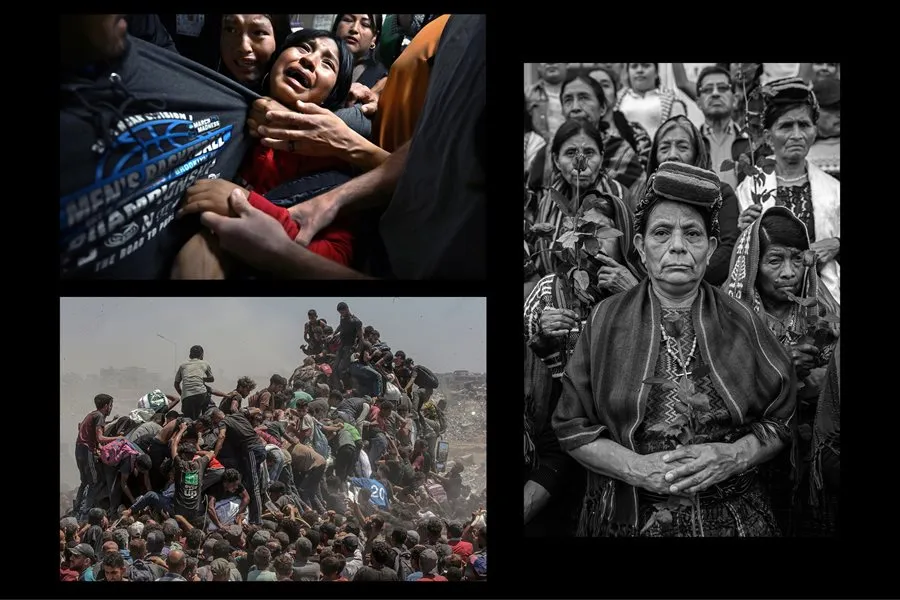

We love to muse over how “real” photography is defined here at The Verge now that generative AI is so prolific, and the World Press Photo competition might have the answer. The prestigious award celebrates the best of photojournalism, where capturing reality is paramount.
The winning entry for 2026 — “Separated by ICE,” captured by photojournalist Carol Guzy — was announced yesterday. The harrowing photograph shows children clinging to their father after an immigration hearing. The photo had to abide by specific rules around the use of AI tools to be eligible for the competition, with the independent, nonprofit organization behind the award setting clear boundaries.
What strikes me most isn’t the photo itself, though it’s powerful. It’s that the contest organizers had to explicitly define what a photograph is in 2026. That’s a sign of how far we’ve come — or how far we’ve fallen, depending on your perspective.
The Rules That Matter
The World Press Photo organization didn’t just say “no AI.” They went further: any image submitted must be a genuine capture of a real moment. You can’t generate or significantly alter the content using generative AI tools. Basic editing like color correction and cropping? Fine. Removing a person from the background with a generative fill? Not fine.
This is higher than I expected. I’ve seen other competitions fudge the line, allowing “creative enhancement” that basically lets you replace half the sky with something more dramatic. World Press Photo draws a harder line, and that’s refreshing.
Why This Matters Beyond Journalism
If you’re a photographer, this ruling affects you even if you never enter a contest. The definition of “photo” is being shaped by these gatekeepers. When a major institution says “this is real, that isn’t,” it sets a precedent that ripples through stock photo sites, newsrooms, and even social media platforms.
I’ve been watching this debate since the first convincing AI images showed up a few years ago. The easy answer was always “just trust the metadata.” But metadata is trivial to fake. The harder answer — and the one World Press Photo is reaching for — is about intent and process. Did you press a shutter button in a real place at a real time, or did you type a prompt?
The Cracks in the Facade
All that said, the rules aren’t perfect. They rely on the honor system and the ability of judges to spot fakes. We’ve already seen AI-generated images slip past human reviewers in other competitions. And the line between “assistive” and “generative” tools gets blurrier every month. What about AI denoising that reconstructs detail from noise? Or AI upscaling that invents texture?
The organization acknowledges this is an evolving challenge. They’re not pretending to have a permanent solution. That honesty is better than the alternative, where contests pretend everything is fine while AI tools get smarter.
The Takeaway I Actually Care About
What I want photographers to take from this isn’t a set of rules. It’s the reminder that the core value of photography has never been technical perfection. It’s been about being there. Carol Guzy was in that courtroom. She saw those kids holding their father. She made a choice about when to press the shutter.
No AI prompt can replicate that. Not yet. And if we’re smart about how we define photography, it never will.
Comments (0)
Login Log in to comment.
Be the first to comment!