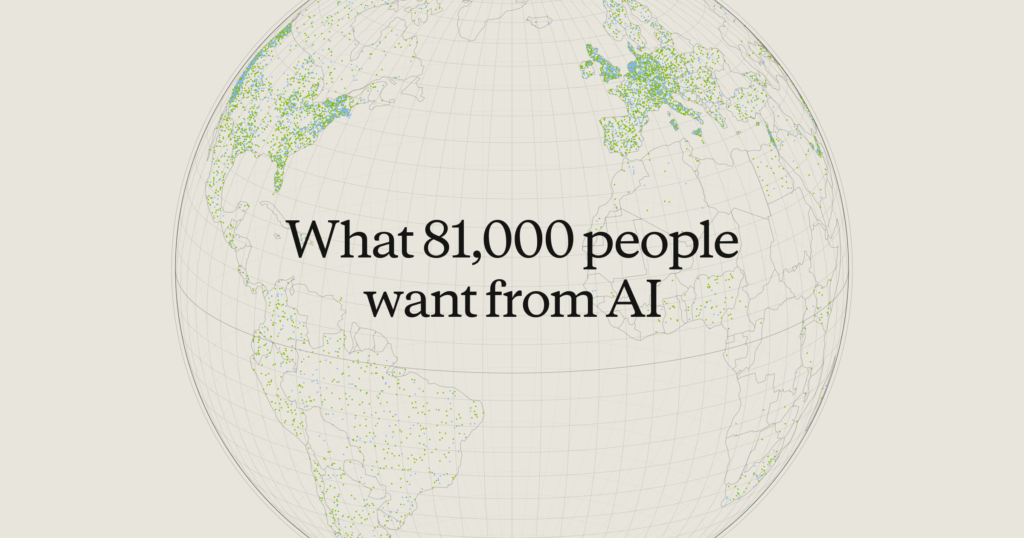

Last December, tens of thousands of Claude users around the world sat down for a chat — not with a human researcher, but with an AI interviewer. Anthropic built a version of Claude specifically prompted to conduct conversational interviews, and over one week, 80,508 people across 159 countries and 70 languages told it how they use AI, what they dream it could enable, and what scares them.
Anthropic claims this is the largest and most multilingual qualitative study ever conducted. I’m inclined to believe them. That’s a staggering amount of open-ended data, and the fact that it spans so many languages and cultures makes it genuinely global in a way most tech surveys aren’t.
What people actually want
The team used Claude-powered classifiers to categorize responses. Each person’s primary desire was classified into a single category, while concerns could be multi-label — because people rarely have just one worry.
Here’s the breakdown of what people hope for:
Professional excellence (18.8%) topped the list. People want AI to handle the grunt work so they can focus on strategic thinking, complex problem-solving, and meaningful work. A healthcare worker from the US said: “I receive 100-150 text messages per day from doctors and nurses. So much of my cognitive labor was spent on documentation… Since implementing AI, the pressure of documentation has been lifted. I have more patience with nurses, more time to explain things to family members.”
Personal transformation (13.7%) came next — people using AI as a coach, guide, or therapeutic support for self-understanding, behavior change, and mental health. One respondent from Hungary said: “AI modeled emotional intelligence for me… I could use those behaviors with humans and become a better person.”
Life management (13.5%) — AI as organizational scaffolding for schedules, mental load, and executive function support. A manager from Denmark put it well: “If AI truly handled the mental load… it would give me back something priceless: undivided attention.”
Time freedom (11.1%) — people want to reclaim hours from work and chores to be present with family or pursue personal passions.
Other desires included learning and education, creativity and expression, access and equity, financial stability, and problem-solving. Notably, some people wanted AI to help with “advancing science and humanity” — a more altruistic category that still made the list.
The tension is real
What struck me most is that hope and alarm don’t divide people into camps. They coexist within each person. A lawyer from Israel said: “I use AI to review contracts, save time… and at the same time I fear: am I losing my ability to read by myself? Thinking was the last frontier.”
A freelancer from the US shared how AI helped with a medical diagnosis: “Claude put the historical pieces together, leading to my proper diagnosis after being misdiagnosed for over 9 years.” Meanwhile, a technical support specialist from the US said: “I got laid off from my job in May because my company wanted to replace me with an AI system.”
An entrepreneur from Nigeria captured the ambivalence: “I live hand to mouth, zero savings. If I use AI smarter, it may help me craft solutions to that cycle. It still depends on me.”
A software engineer from South Korea raised the existential concern: “Humanity has never dealt with something smarter than itself. We need to reflect on how to prepare for the AI age.”
What people fear
The study also classified concerns. I wish Anthropic had published the full breakdown, but the truncated content I saw mentioned job displacement, skill erosion, loss of human connection, and loss of control. These aren’t new fears, but hearing them from real users — not pundits — makes them hit differently.
The method matters
Anthropic used a clever approach: an AI interviewer that asked a standard set of questions, then adapted follow-ups based on responses. This bridges the typical tradeoff in qualitative research between depth and volume. Normally you either get rich interviews with 50 people or shallow surveys with 50,000. Here they got both.
They also built classifiers to categorize the conversations and used Claude to pull representative quotes. All responses were de-identified before analysis, and quotes selected for publication underwent manual review to remove any potentially identifying details. Privacy-conscious, which I appreciate.
What’s missing
The study is impressive in scale, but it’s self-selecting. These are people who already have Claude.ai accounts — they’re early adopters, likely more tech-savvy and optimistic than the general population. The concerns of people who don’t use AI at all are absent. That’s a limitation Anthropic acknowledges in the appendix.
Still, 80,508 voices from 159 countries in 70 languages is a hell of a start. If you want to hear directly from people, Anthropic built a Quote Wall where you can filter by region, concern, vision, and more. It’s worth browsing.
For once, the “what do people actually want?” question has a real answer — and it’s more nuanced than the usual tech utopia vs. dystopia binary.
Comments (0)
Login Log in to comment.
Be the first to comment!