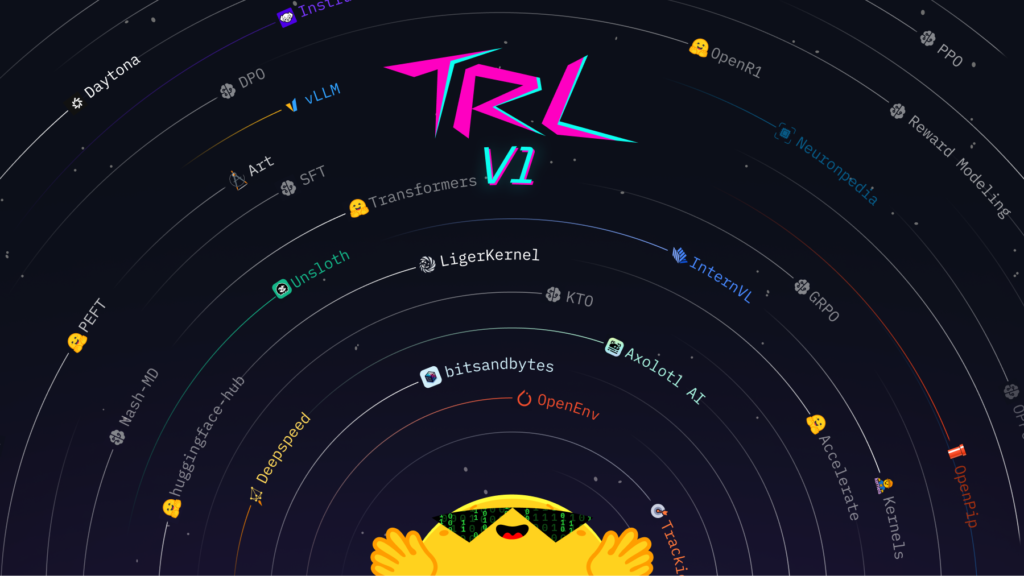

Hugging Face just dropped TRL v1.0, and this isn’t your typical version bump. This is the moment a research codebase admits it’s been acting like production infrastructure for a while now.
The numbers tell part of the story: 3 million downloads a month, projects like Unsloth and Axolotl built directly on top of it. But what’s more interesting is how they got here. TRL didn’t set out to be a library. It became one because people started depending on it, and v1.0 is the formal acknowledgment of that responsibility.
The moving target problem
Post-training has been a mess of shifting paradigms, and TRL had to survive all of them. PPO made the RL stack look canonical — policy, reference model, reward model, rollouts. Then DPO came along and said you don’t need half of that. Then GRPO brought back sampling but changed what the objects in the loop actually are.
The lesson here isn’t that methods change. It’s that the definition of the core keeps changing. Reward models looked essential, became optional, and then came back as verifiers — deterministic functions instead of learned models. Any abstraction built around their original form would be obsolete twice over by now.
I’ve seen this pattern in other ML infrastructure projects. The ones that survive aren’t the ones with the most elegant abstractions. They’re the ones that design for their own obsolescence.
Stable and experimental under the same roof
This is where TRL’s design gets interesting. They don’t force you to choose between stability and bleeding-edge features. Stable and experimental live in the same package, with explicitly different contracts.
The stable core follows semantic versioning. The experimental layer makes no such promises — it’s where new methods land while they’re still being evaluated, and the API can move fast.
from trl import SFTTrainer
from trl.experimental.orpo import ORPOTrainer
This isn’t a compromise. It’s a response to a real constraint: the field produces new methods faster than any of them can earn stability. Refusing to add immature methods would make TRL irrelevant within months. Adding them all to stable would break every downstream project every time an algorithm turns out not to work.
Promotion from experimental to stable isn’t automatic. What matters is the ratio between maintenance cost and actual usage. Some methods earn their place because the community uses them heavily. Others become viable because the codebase design makes them cheap enough to maintain.
What actually changed
The breaking changes needed to reach v1.0 were distributed deliberately across the 0.x releases, so the migration isn’t as painful as it could have been. The stable surface now includes trainers for SFT, DPO, Reward modeling, RLOO, and GRPO, along with their close variants. The experimental surface is broader and moves faster.
More than 75 post-training methods are implemented, but coverage isn’t the goal by itself. What matters is making these methods easy to try, compare, and actually use in practice. The design wasn’t decided upfront — it’s the result of years of iteration, with the first commit going back more than six years.
Parts of the codebase might look unusual at first. But like in many evolutionary codebases, they exist for a reason. The field keeps throwing new algorithms, new models, shifting paradigms at it, and the pressure forced the codebase toward a very specific design.
The real takeaway
TRL v1.0 is an admission that no post-training library is really stable yet, and that’s fine. The question isn’t how to design the perfect abstraction. It’s how to make stable software in a domain that keeps invalidating its own assumptions.
The answer, apparently, is to embrace the chaos rather than fight it. Let stable and experimental coexist. Don’t make strong assumptions about what the core looks like. And when the field shifts again — because it will — make sure your codebase can shift with it.
Comments (0)
Login Log in to comment.
Be the first to comment!