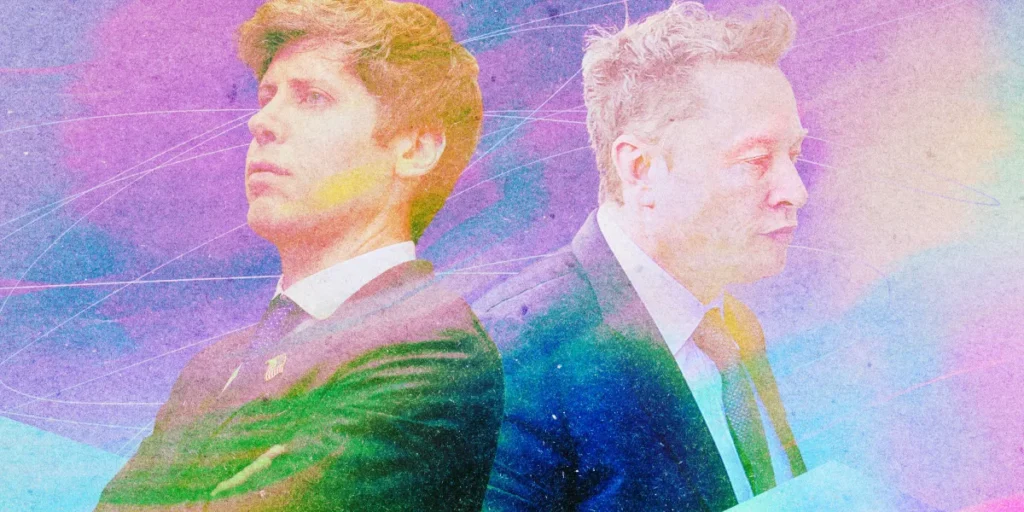

After years of legal posturing, Elon Musk and Sam Altman are finally going to trial this week in Northern California. The case could have sweeping consequences for OpenAI, its upcoming IPO, and the broader AI industry. The court might rule on whether OpenAI can exist as a for-profit enterprise, and could even oust its current executive leadership, including Altman.
Musk is suing OpenAI, alleging that Altman and president Greg Brockman tricked him into bankrolling the company in its early days. The promise was simple: keep OpenAI as a nonprofit dedicated to developing AI that benefits humanity. Instead, Musk claims, they later restructured the company to operate a for-profit subsidiary. He cofounded OpenAI with Altman and others in 2015, but left in 2018 after a bitter power struggle.
Musk is seeking up to $134 billion in damages from OpenAI and Microsoft, one of OpenAI’s biggest financial backers. He’s also asking the court to remove Altman and Brockman from their roles and restore OpenAI as a nonprofit. Interestingly, Musk wants any damages awarded to OpenAI’s nonprofit, not to himself personally.
Nine jurors will deliver an advisory verdict—a non-binding recommendation—to guide the judge in deciding Musk’s claims against Altman. Musk, Altman, and Brockman will take the stand. Former OpenAI chief scientist Ilya Sutskever, former CTO Mira Murati, and Microsoft CEO Satya Nadella are also expected to testify. Expect cringey texts, raw diary entries, and endless scheming behind the founding and growth of OpenAI to come to light.
In an industry shrouded in secrecy, this trial is a rare chance for the public to see what’s really happening inside the companies building the most transformative technology ever. Let’s be honest: we all want to know what those late-night emails looked like.
What’s the actual fight about?
When OpenAI was founded as a nonprofit, backed by a $38 million donation from Musk, it vowed to create open-source technology for the public’s benefit—unconstrained by a need to generate financial returns. But over time, the company argued that intensifying competition made it dangerous to share how it develops its AI models, and that a nonprofit structure couldn’t raise enough money to keep building AI. (MIT Technology Review was first to report on OpenAI’s internal conflicts around its mission.)
The court has already found that in 2017, Altman and Brockman wanted to establish a for-profit arm, while Musk proposed merging OpenAI with Tesla. When Musk threatened to stop funding, Altman and Brockman told him they were committed to keeping the company a nonprofit. Musk alleges they pursued plans to pivot to for-profit without informing him. According to OpenAI, Musk agreed the company needed a for-profit entity and even wanted to be its CEO.
But even if Musk proves he was duped, he may not have standing to sue for restructuring the company. Some legal scholars are puzzled over why the judge allowed this claim. “The idea that Elon Musk can sue because he was a donor or used to be on the board is pretty puzzling,” says Jill Horwitz, a law professor who studies nonprofit law at Northwestern University. “Typically, it’s up to the attorneys general to bring such a claim to enforce the charitable purposes. And that’s already happened.”
In October 2025, state attorneys general of California and Delaware struck a deal with OpenAI to approve its new corporate structure on conditions. For example, a safety and security committee at the nonprofit would review safety-related decisions made by the for-profit subsidiary. Critics of the restructuring—including Musk, AI safety advocates, and civil society groups—have tried to stop it. California’s attorney general has declined to join Musk’s lawsuit, saying the office didn’t see how his action serves the public interest.
Why this trial matters beyond the drama
Whether the deal holds OpenAI to its nonprofit mission is an open question. “Elon Musk should have to show what the deficiencies are in what’s been agreed to by OpenAI with the attorneys general,” says Rose Chan Loui, director of the UCLA School of Law’s nonprofit program. That’s a fair point: if Musk can’t demonstrate actual harm, this could end up being a very expensive exercise in ego.
But let’s be real: this trial is about more than legal technicalities. It’s about who controls the future of AI. OpenAI’s transition from a nonprofit to a capped-profit structure has always felt like a bait-and-switch to many in the community. The company’s original mission—to ensure that artificial general intelligence benefits all of humanity—has been increasingly overshadowed by commercial interests. Microsoft’s deep involvement, the massive funding rounds, and the relentless push for productization have left many wondering if OpenAI is still the organization it claimed to be.
Musk, for all his flaws, has a point: if you promise to build AI for humanity’s benefit and then pivot to a for-profit model that enriches a few, you’ve broken that promise. But Musk is also not exactly a neutral party here. He left OpenAI after losing a power struggle, and he’s now running his own AI company, xAI. There’s a strong argument that this lawsuit is as much about business rivalry as it is about principle.
The trial will also expose the messy reality of how AI companies operate. Expect testimony from former employees, internal documents, and emails that reveal the tension between idealism and capitalism. This is the kind of transparency the industry desperately needs, even if it comes through a courtroom.
What’s at stake for the rest of us
If the court rules against OpenAI, it could force the company to restructure again, potentially derailing its IPO and shaking investor confidence. That would have ripple effects across the AI industry, where OpenAI has been a bellwether for commercial viability. A ruling that removes Altman and Brockman would be even more dramatic, though it seems unlikely given the legal hurdles.
But the bigger question is about precedent. If a founder can sue to enforce a nonprofit mission years later, what does that mean for other AI companies that started with altruistic promises and later embraced profit? It could open the floodgates for similar lawsuits, or it could be a one-off driven by Musk’s deep pockets and determination.
Either way, this trial is a reminder that the AI industry’s founding myths are being tested in court. The public gets to see the sausage being made, and it’s not going to be pretty. I’m not sure any of us will come away feeling better about the people building our future.
Comments (0)
Login Log in to comment.
Be the first to comment!