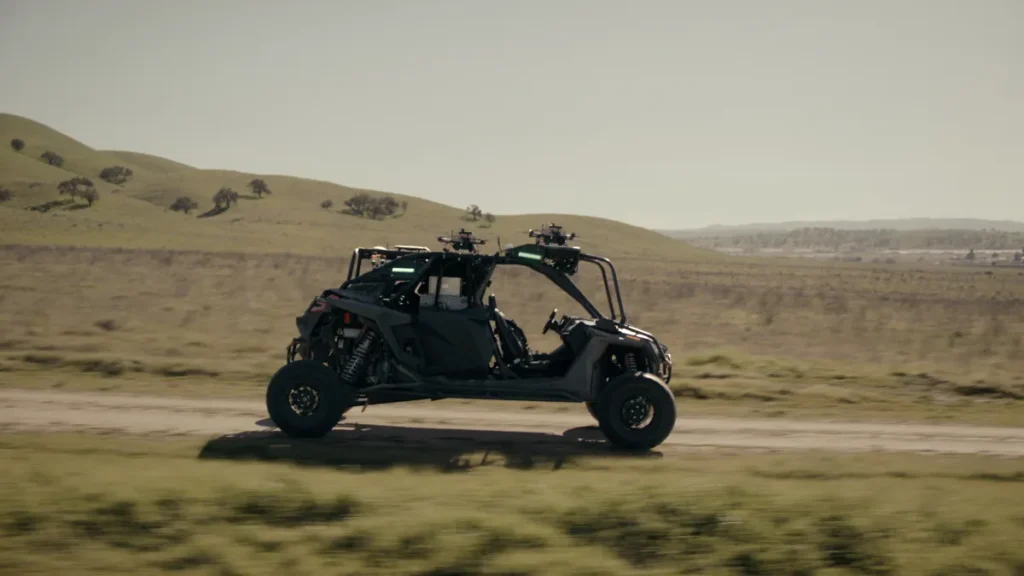

Colby Adcock’s Scout AI just locked in a $100M round to do something that makes a lot of people uncomfortable: train AI models for war. Specifically, they’re building agents that let a single soldier control entire fleets of autonomous vehicles—drones, ground bots, you name it. I went to their training ground to see what that actually looks like.
First, let’s get the obvious out of the way. Military AI is a touchy subject. Some people see it as inevitable, others as a line we shouldn’t cross. I’m not here to settle that debate, but I can tell you what I saw: a bootcamp that feels more like a tech startup’s hackathon than a war room. The vibe is intense but not grim. Engineers in hoodies huddle around laptops, tweaking models while drones buzz overhead. It’s weirdly normal.
The core idea is straightforward: give a soldier a tablet or a headset, and let them direct a swarm of drones like they’re playing a real-time strategy game. No joysticks, no individual controls. Just high-level commands—”scout that ridge,” “cover this flank,” “intercept that target”—and the AI figures out the rest. Each drone or vehicle runs a lightweight model that communicates with the others, forming a decentralized mesh network. If one unit goes down, the swarm reconfigures automatically.
What impressed me most was the training pipeline. Scout doesn’t just feed data into a black box and hope for the best. They run simulated battles—thousands of them—in environments that mirror real terrain. The models learn from every encounter, including failures. I watched a simulation where a drone swarm got wiped out by a simulated anti-air system, and the engineers immediately pulled the logs to figure out why. They treat every mistake as a data point, not a setback.
The $100M is going toward scaling this. More simulations, more hardware, more edge deployments. They’re also hiring like crazy—mostly reinforcement learning engineers and robotics folks. The goal is to get these agents into the field within two years, not five. That timeline feels aggressive, but after seeing how fast they iterate, I’m not sure it’s unrealistic.
There are questions, of course. How do you ensure the AI doesn’t make catastrophic mistakes under pressure? What happens when an enemy jams the swarm’s communication? Scout claims they’ve built in fail-safes—manual overrides, kill switches, redundancy layers—but nobody really knows how this stuff behaves in a chaotic, real-world firefight. The demo was controlled. War isn’t.
Still, I get why the funding came through. The US military has been talking about manned-unmanned teaming for years, but most solutions are clunky and centralized. Scout’s approach—decentralized, adaptive, soldier-first—feels like a genuine leap. Whether that leap is toward something we want is a different conversation. But as a piece of engineering, it’s hard not to be impressed.
I left the bootcamp with mixed feelings. The tech is undeniably cool. The people are smart and earnest. But the application is war, and that’s heavy. Scout isn’t trying to hide that. They’re building for the battlefield, and they’re building fast. Whether you think that’s necessary or dangerous, it’s happening. And now they have another $100M to make sure it happens on their terms.
Comments (0)
Login Log in to comment.
Be the first to comment!