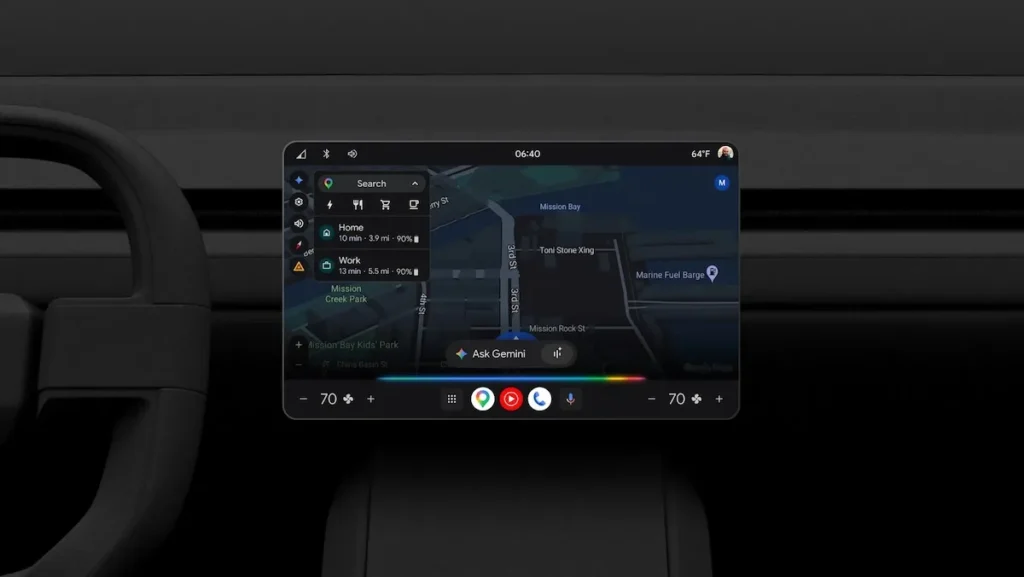

Google announced Thursday that Gemini is finally hitting the road—literally. Starting now, cars with Google built-in (that’s the native Android Automotive system, not just Android Auto on your phone) will get Gemini as the default voice assistant. It’s a straight upgrade from the old Google Assistant, which has been doing the heavy lifting in these cars for years.
The timing is interesting. Just yesterday, General Motors revealed it’s also integrating Gemini into its vehicles, so it’s clear Google is pushing hard to get this conversational AI into every dashboard it can. I’ve been testing Google built-in in a few rental cars over the past year, and honestly, the Assistant was fine for basic stuff—navigation, music, calls—but it struggled with anything remotely complex. Ask it to find a coffee shop that’s open and has good parking? It’d either misunderstand or give you a generic list. Gemini should handle that kind of nuance much better, since it’s built on the same underlying model that powers the web version.
What does this actually mean for drivers? Google says Gemini can handle multi-step requests like “Find a charging station along my route and send the address to my phone” or “Remind me to pick up groceries when I get near a supermarket.” It can also summarize text messages and draft replies, which is a feature I’ve wanted for ages. The old Assistant could barely read a text without mangling it.
But here’s my concern: this is a lot of AI in a context where distraction is already a massive problem. I get that voice assistants are supposed to keep your hands on the wheel and eyes on the road, but the more capable they get, the more tempting it becomes to offload complex tasks while driving. Google says it’s designed the system to minimize cognitive load, but I’ve seen enough demos where the AI takes five seconds to process a request and then spits out a verbose response. That’s not great when you’re merging onto a highway.
Still, the upgrade is rolling out to “millions of vehicles” already on the road, according to Google’s announcement. That includes Volvo, Polestar, Renault, and some GM models. If you’ve got a car with Google built-in, you should see the Gemini prompt appear gradually over the next few weeks. You can also switch back to the old Assistant if you prefer, which is a nice touch. I suspect most people will stick with the default out of inertia, but at least the option is there.
One thing I haven’t seen mentioned much is how this affects data usage. Google built-in already requires a data connection for navigation and streaming, but Gemini’s conversational AI is going to be more data-hungry. If you’re on a limited plan, you might want to keep an eye on that. Google hasn’t said whether it’ll compress queries differently for the car, but I’d hope they’ve optimized for latency and bandwidth.
Overall, this is a solid step forward for in-car voice assistants. The old Assistant was showing its age, and Gemini brings genuine improvements in understanding and responsiveness. But I’m not convinced we need a full-blown LLM in the car just yet. Let’s see how it handles real-world driving conditions before we declare it a game-changer.
Comments (0)
Login Log in to comment.
Be the first to comment!