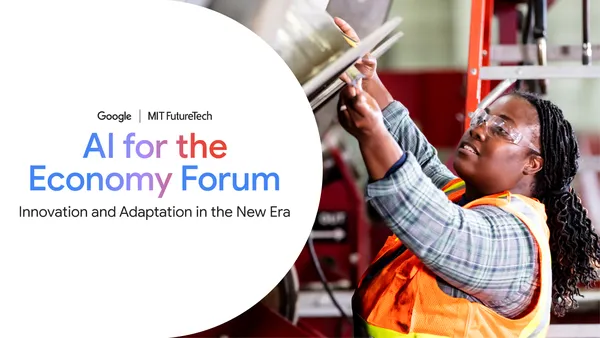

I’ve been watching the AI-and-jobs debate for a while now, and it’s rare to see a forum that doesn’t devolve into either hype or doom. Google and MIT FutureTech’s inaugural AI for the Economy Forum in Washington D.C. this week actually tried to do something useful: bring economists, policymakers, industry folks, and workers together to talk about how AI will change the economy—and what we can do about it.
The framing was refreshingly honest. Neither the benefits nor the risks are automatic. That’s not just PR speak—it’s a recognition that the outcome depends on choices we make now. Google’s SVP James Manyika, who’s been thinking about this stuff for years, made that point clearly. I appreciate that they’re not pretending this is a done deal.
New research money, but will it matter?
Google announced an AI & Economy Research Program, which is basically a funding pipeline for academic work on AI’s economic impact. They’re bringing in visiting fellows like MIT’s David Autor—whose work on labor markets I’ve followed for ages—and supporting projects like Ben Armstrong and Julia Shah’s study on how firms can use AI to reduce drudgery instead of just replacing workers. That study found the most success came from AI tools that minimize boring tasks, promote learning, and foster collaboration. No surprise there, but it’s good to see actual data backing up what many of us suspected.
They’re also throwing in Google.org funding and Cloud credits for a global cohort of researchers looking at sector-specific transformations in manufacturing and healthcare, labor market impacts, and policy environments. And they’ve got a heavyweight advisory board: Nobel Laureate Michael Spence, Cambridge’s Dame Diane Coyle, and Mohamed El-Erian. That’s a solid lineup.
But here’s the thing: research funding is great, but the real test is whether governments and companies actually use the findings. I’ve seen too many well-funded studies gather dust. Google’s track record on actually implementing research insights is mixed—they’re good at producing data, less good at acting on it when it conflicts with their product roadmap. We’ll see.
Training programs: the usual suspects, plus healthcare
On the training side, Google is doing what they’ve done before but scaling it up. They’re funding programs to train healthcare workers and create apprenticeships in high-demand fields. That’s sensible—healthcare is one area where AI could genuinely help without massive job displacement, because there’s a chronic shortage of workers anyway.
The apprenticeships part is interesting. They’re not just throwing money at online courses; they’re actually partnering with employers to create on-the-job training. That’s harder to do but more effective. I’ve seen too many “learn to code” initiatives that leave people with certificates but no job offers. Apprenticeships at least give you a foot in the door.
Still, I wish they’d talk more about what happens to the people whose jobs get automated away. The forum mentioned “navigating a changing economy,” but that’s vague. Retraining is one thing; income support during transition is another. Google’s not a government, so I don’t expect them to solve that, but pretending training alone will fix everything is naive.
What’s missing from the conversation
The forum focused on research and training, which are necessary but not sufficient. Missing from the announcement: any serious discussion of labor market regulation, universal basic income experiments, or how to handle the gig economy’s intersection with AI. Those are harder topics, but they’re the ones that will determine whether AI widens inequality or narrows it.
Also, the forum was in D.C., which means it’s heavy on policy wonks and light on actual workers. I’d love to see more representation from people who are currently in jobs that AI will change—manufacturing line workers, call center agents, truck drivers. Their voices are usually absent from these rooms.
Bottom line
Google’s AI for the Economy Forum is a step in the right direction. The research investments are real, the advisory board is credible, and the training programs have practical elements. But the proof will be in whether any of this leads to policy changes or corporate behavior shifts. I’m cautiously optimistic, but I’ve been burned before. Let’s check back in a year and see if the forum was just a nice event or an actual catalyst.
Comments (0)
Login Log in to comment.
Be the first to comment!