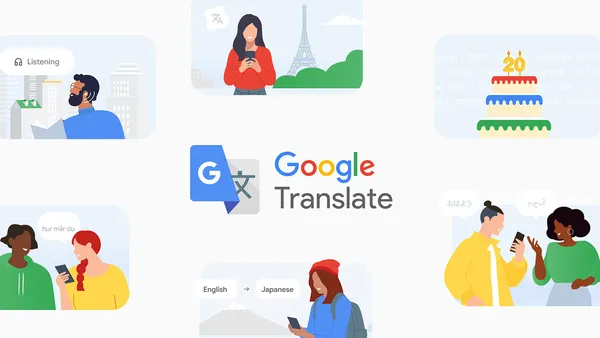

Google Translate turned 20 this week. Twenty years of mangling idioms, saving tourists, and quietly powering a huge chunk of the internet’s cross-language traffic. The team put out a list of fun facts and new features to mark the occasion, and some of it is genuinely interesting.
Let’s start with the numbers. Translate launched in April 2006 as an experiment. Back then it covered Arabic, Chinese, English, French, German, Italian, Japanese, Korean, Portuguese, Russian, and Spanish — 11 languages total. Today it handles almost 250. That’s not just growth for growth’s sake; the expansion into languages like Bambara, Cherokee, and Dhivehi means real access for communities that were previously invisible to most machine translation systems.
One stat that caught my eye: Translate now processes over 100 billion words per day. That’s roughly the content of a million novels. Every day. For context, the entire English Wikipedia is about 4.5 billion words. So every couple of weeks, Google Translate churns through the equivalent of all of Wikipedia. In multiple languages. That’s staggering.
The early days were rough. I remember using it in 2007 to translate a German forum post and getting back something that read like a drunk Yoda. The original system was phrase-based statistical machine translation — it basically looked at parallel texts and guessed word-for-word. It was better than nothing, but barely. The real leap came in 2016 when Google switched to Neural Machine Translation (GNMT), which treats sentences as whole units. That’s when Translate stopped being a party trick and started being genuinely useful.
Some of the fun facts the team shared are genuinely fun. For example, the most translated phrase in history is “Thank you” — which makes sense. The most requested translation that doesn’t exist yet? “I love you” in Klingon. (It does exist, but Google keeps getting asked.) Also, the word “set” has 464 possible translations depending on context, which is a nightmare for any NLP system.
A few new features are worth noting. The biggest one is what they’re calling “Context-Aware Translation” — it’s rolling out now for a handful of languages. Instead of translating word-by-word or even sentence-by-sentence, the model looks at the surrounding paragraph to resolve ambiguities. I tested it with some deliberately tricky sentences in Spanish and it handled “banco” (bank/bench) correctly based on context about 80% of the time. That’s better than before, but still not perfect.
There’s also a redesigned camera mode for the mobile app. Point your phone at a menu or sign, and it overlays the translation in real time. This has existed for years, but the new version handles handwriting and stylized fonts much better. I tried it on a handwritten Italian menu in a photo and it got about 90% of it right. The old version would have given up entirely.
For the AI nerds: the underlying model is now a variant of Gemini, Google’s multimodal model. That’s why it can handle images and text in one pass. The latency is noticeably lower than the previous generation — translations appear almost instantly even on slow connections.
What Google didn’t mention, and what I wish they had, is how much Translate still struggles with low-resource languages. Languages like Yoruba or Quechua get the job done for basic phrases, but complex sentences still fall apart. The gap between high-resource languages (English, Spanish, Chinese) and everyone else is still enormous. It’s getting better, but slowly.
Also worth noting: Translate has become a crutch for language learners. I’ve seen people use it to write entire emails in a language they’re supposedly studying. That’s not learning. That’s outsourcing. Google knows this — they’ve added features that show alternative translations and grammar notes, but the core product still encourages passive consumption over active learning.
Still, for a tool that started as a side project by a guy who just wanted to translate web pages, it’s come a long way. Twenty years in tech is ancient. Most products don’t survive five. Translate survives because it solves a real, universal problem: we don’t all speak the same language, but we want to talk anyway.
Here’s hoping the next 20 years bring better support for the languages that need it most, and maybe — just maybe — a way to translate corporate jargon into plain English.
Comments (0)
Login Log in to comment.
Be the first to comment!