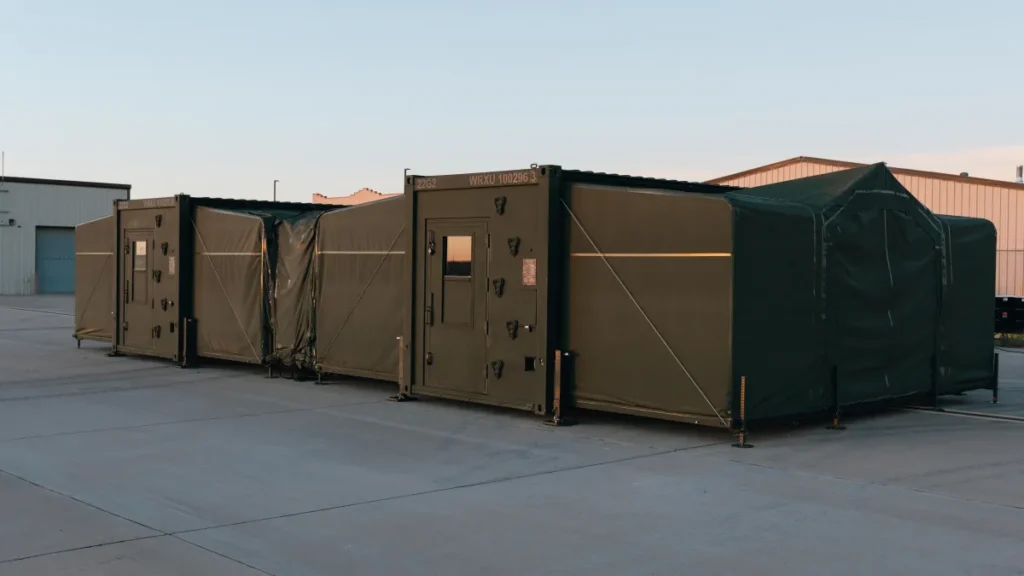

A defense startup just pulled in $82 million to do something that sounds almost too practical to be real: stuff a drone factory into a shipping container and roll it right up to where the fighting happens.
Firestorm Labs, the company behind this, isn’t trying to build the next flashy autonomous fighter jet. They’re solving a much more mundane problem that I’ve seen plague military logistics for years: getting drones to the front line takes too damn long. By the time a unit orders a replacement drone, it’s shipped from a factory somewhere safe, and arrives weeks later, the mission has already changed or the opportunity is gone.
Their approach is refreshingly direct. They design drones that can be manufactured inside standard intermodal shipping containers. These containers are already how the military moves everything from food to ammunition, so slotting a factory into that ecosystem makes sense. The container gets dropped off near a forward operating base, troops plug it in, and start printing drone parts. Assembly, testing, and deployment all happen within a few hundred meters of where the drone will fly.
The $82 million round is sizable, higher than I expected for a company that’s still relatively young. It tells me investors see this as more than just a niche logistics hack. The Pentagon has been vocal about wanting distributed manufacturing capabilities, and Firestorm is betting that the future of drone warfare isn’t about having the most advanced drone, but about having the most available one.
I’ve seen similar concepts tried before, usually with 3D printing or modular assembly lines, but they always hit the same wall: the equipment is too fragile, too power-hungry, or requires skilled operators you can’t spare. Firestorm claims their container factory is ruggedized, runs on standard military power, and can be operated by personnel with basic technical training. I’ll believe it when I see field reports, but the funding suggests they’ve convinced some serious people.
The drones themselves aren’t exactly cutting-edge airframes. They’re designed for specific tactical roles: surveillance, loitering munitions, cargo resupply. Nothing that will win a design award. But that’s the point. They’re meant to be simple enough to produce quickly and cheaply enough that losing one isn’t a crisis. If a $50,000 drone gets shot down, that hurts. If a $5,000 drone that you built this morning in a box gets shot down, you shrug and build another.
There’s also an interesting angle here for non-military use. Disaster response teams, remote research stations, or even commercial agriculture operations in isolated areas could theoretically benefit from the same concept. But Firestorm is laser-focused on defense contracts for now, and that $82 million will go toward scaling production and getting these container factories into the hands of early adopters in the field.
I’m curious to see how this holds up under real operational stress. Shipping containers get banged around. Desert sand gets everywhere. Power fluctuates. The military has a long history of great ideas that died in the field because they couldn’t handle the environment. But if Firestorm’s container factories actually work, they could change how quickly drones get into the air. And in modern warfare, speed matters more than specs.
Comments (0)
Login Log in to comment.
Be the first to comment!