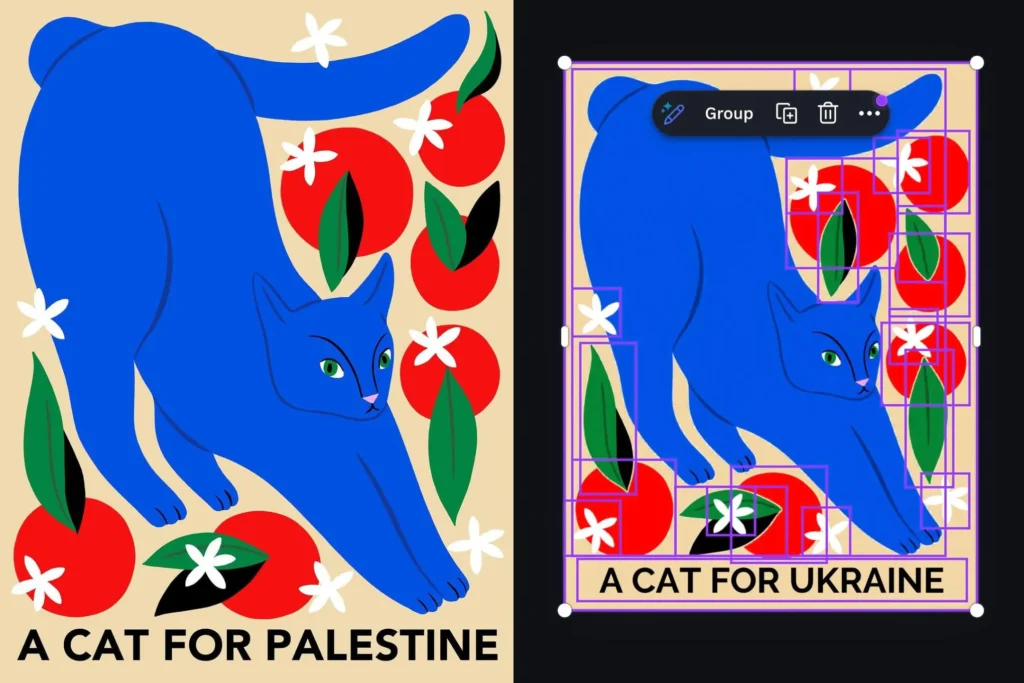

I suddenly feel so much better about every embarrassing typo I’ve ever made. Because at least none of my autocorrect fails have ever swapped a country name for a different one — mid-design, without warning, and with geopolitical implications.
That’s exactly what happened to someone on X (formerly Twitter) this week. User @ros_ie9 was using Canva’s Magic Layers feature — the one that’s supposed to intelligently separate flat images into editable components — when they noticed something off. The AI had quietly changed the phrase “cats for Palestine” to “cats for Ukraine.”
Not a typo. Not a suggestion. The text was altered, automatically, by the tool.
Now, Magic Layers isn’t supposed to make visible edits to your design at all. Its whole pitch is that it breaks apart layers so you can tweak them, not that it rewrites your copy. So this isn’t just a bad suggestion from an LLM — it’s a feature silently overriding user input.
The most telling detail? The issue seemed specific to the word “Palestine.” Related terms like “Gaza” were left untouched. That’s not random noise in a training set. That looks like a filter, or a moderation rule, gone rogue.
Canva acknowledged the issue and said it’s been resolved, with additional steps to prevent recurrence. They didn’t go into detail about what caused it, but given how targeted the behavior was, I’d bet my morning coffee this wasn’t a simple training data glitch. More likely, it’s an overzealous content policy that got baked into the model’s inference logic — and nobody caught it until a user did.
This is the kind of thing that makes me uneasy about the rush to embed AI into every creative tool. Not because AI is inherently bad, but because the failure modes are invisible until they bite someone. A spelling mistake is obvious. A model silently rewriting your design? You might never know.
Canva’s apology is fine as far as corporate damage control goes, but it doesn’t address the deeper issue: when you give an AI the ability to alter user content, you need to test it against real-world edge cases — not just the ones that look good in a demo. “Cats for Palestine” is harmless. But what if the next swap involves something more consequential?
Let’s hope this incident pushes Canva — and every other company shipping similar features — to audit their models for this kind of silent censorship. Because the last thing we need is AI deciding which words get to stay in our designs.
Comments (0)
Login Log in to comment.
Be the first to comment!