
If you want to live forever, the obvious bottleneck is your body. It ages, breaks down, eventually gives up. So why not just swap it out for a fresh one?
That’s the pitch from R3 Bio, a small, stealthy startup that’s been making the rounds in biotech circles. Their vision: grow genetically identical human bodies — clones — but without a functioning brain. Just empty vessels, ready to be occupied.
Yes, you read that right. Brainless human clones as spare parts.
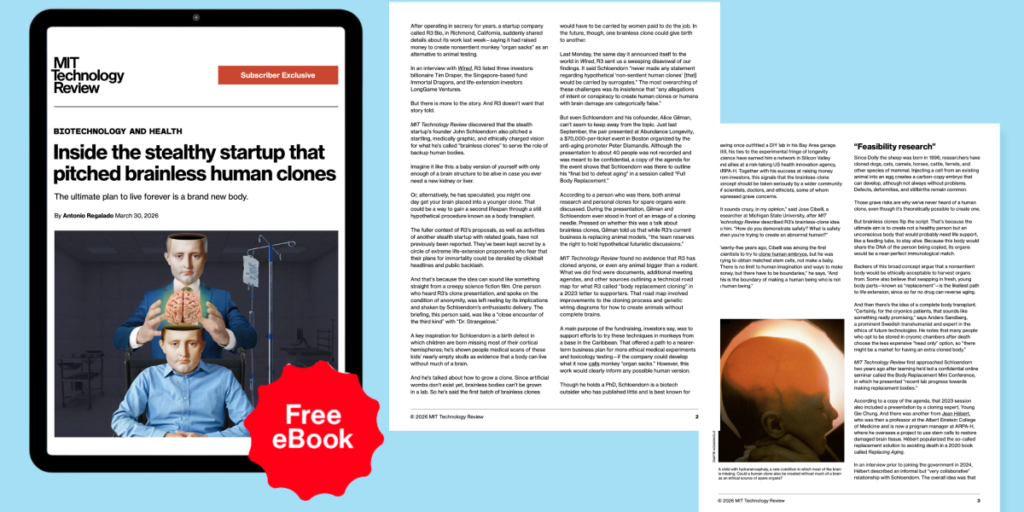
MIT Technology Review’s Antonio Regalado got a look at their internal pitch deck and published an exclusive eBook on the whole thing. I finally sat down to read it, and honestly, it’s one of those ideas that sounds plausible enough to be terrifying.
The Basic Idea
R3 Bio isn’t trying to clone a person. They’re trying to clone a body. The distinction matters because the ethical calculus shifts dramatically when you remove consciousness from the equation.
Their approach leans on recent advances in stem-cell biology and synthetic embryology. We’ve gotten disturbingly good at growing organoids — miniature, simplified versions of organs — in labs. R3 wants to scale that up to the whole organism level, but with a critical genetic edit that prevents the development of a forebrain or any structures capable of supporting consciousness.
You end up with a human-shaped biological shell. Heart, lungs, liver, kidneys — all there. But nobody home.
The Practical Hurdles
Let’s be real for a second. We can barely keep lab-grown heart tissue beating reliably. The idea of growing a fully functional, vascularized, immune-compatible human body is so far beyond current capabilities that it’s almost science fiction.
But that’s not the only problem. Even if you could grow such a body, you’d still need to transplant the original person’s brain into it. That means severing the spinal cord, reconnecting billions of neural connections, and somehow preserving the personality, memories, and sense of self during the transfer.
There’s a researcher mentioned in the piece who’s working on a gradual approach — replacing brain tissue bit by bit with lab-grown equivalents. That’s its own kind of wild, but at least it doesn’t involve decapitating someone and hoping for the best.
The Ethics Are a Mess
I’m not going to pretend I have clean answers here. The obvious objection is that you’re creating human life — or something close to it — for the sole purpose of harvesting its organs. Even if the clone lacks consciousness, it’s still a human body. Where do you draw the line?
Then there’s the slippery slope. If we accept brainless clones as spare bodies, what’s next? Clones with minimal brain function for basic maintenance? Clones that can feel pain but not think? The biotech industry has a terrible track record with “just this one exception” arguments.
And let’s not ignore the inequality angle. This technology, if it ever works, will be for the ultra-wealthy. The rest of us get to die normally while billionaires swap into fresh twenties like they’re changing cars.
My Take
I’ve been following regenerative medicine for over a decade, and I’ve learned to be skeptical of anything that promises to “solve death.” The hype cycle in biotech is brutal. Companies raise huge sums on elegant PowerPoint decks, then quietly fold when the biology doesn’t cooperate.
R3 Bio might be different. They might have real science behind them. But the fact that they’re operating in stealth mode, pitching this to investors behind closed doors, makes me uneasy. If your technology is ethical and viable, you should be able to defend it in public.
That said, the underlying research into synthetic embryos and organ growth is genuinely important. Even if the full-body clone never materializes, the work could lead to better transplant options, drug testing models, and treatments for degenerative diseases.
I just wish they’d lead with that instead of the immortality angle. It’s flashier, sure, but it also invites the kind of backlash that can kill promising research before it gets a fair hearing.
Antonio Regalado’s full eBook is behind MIT Technology Review’s paywall, but the related stories are worth reading if you have access. This is one of those rare cases where the reality is probably weirder than what gets published.
Comments (0)
Login Log in to comment.
Be the first to comment!